
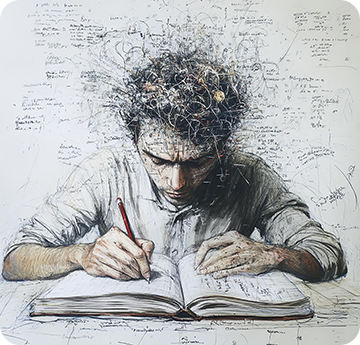
The Noise in IR’s Head: Writing Mental Chaos Without Losing the Reader
In the IR Carnival Trip, the chaos doesn’t begin with explosions or car chases. It begins with a hum.
A fluorescent light. A lawyer’s voice. A room that feels slightly tilted. Then a question that lands harder than it should: “I mean—it’s not like I’m crazy or anything. …Right?”
From the very first chapter of 2Jan26_Marcos_Velazquez_Proofread_Formatted.docx, we’re inside IR’s head. Not just observing him. Not diagnosing him. Inside. And that’s what makes the book compelling. It shows how to write mental chaos in a way that feels immersive without leaving the reader confused.
For writers interested in psychological depth, IR’s journey is a strong case study in how to portray intrusive thoughts, paranoia, and emotional overload while keeping the story grounded and readable.
Let’s break down how it works.
Writing Internal Conflict That Feels Real
Mental chaos on the page can easily turn messy. Too many fragmented thoughts, and the reader checks out—too much explanation, and it feels clinical.
What this book does well is anchor IR’s intrusive thoughts in physical sensations.
When the buzzing in his head rises, it’s not just “he felt anxious.” It’s:
- His heart is thudding.
- His hands are clenched.
- The room is tilting.
- The attorney’s voice sounded hollow and distant.
That grounding matters.
Instead of telling us IR is overwhelmed, the writing shows it through body language and sensory detail. The mind spirals, but the scene stays rooted in reality. Readers always know where they are—even if IR doesn’t fully trust what he’s experiencing.
That’s the key to writing believable internal conflict:
- Let thoughts loop naturally.
- Pair mental tension with physical reactions.
- Keep the character interacting with the world.
IR questions whether he’s “crazy,” whether others understand him, whether something is off. Those questions repeat. They circle. They don’t resolve neatly. That repetition feels human.
Intrusive thoughts rarely come in tidy paragraphs. They come in bursts. Doubts. Half-finished sentences.
The book mirrors that without overwhelming the page.
Balancing Confusion with Clarity
One of the biggest risks in writing psychological tension is losing the reader inside the character’s confusion.
IR experiences déjà vu. He senses things that feel slightly wrong. He sees figures that may or may not be suspicious. His thoughts blur with memory. But the narrative itself stays structured.
Here’s how that balance works:
- Scenes have clear beginnings and endings.
- Dialogue pulls us back into shared reality.
- Other characters respond normally.
For example, when IR zones out or drifts into suspicion, Jimmy’s humor interrupts. Mr. Cooper’s authority grounds the room. Cindy’s presence softens the spiral.
The outside world acts as an anchor.
That contrast is powerful. It allows readers to feel IR’s instability without questioning what’s happening in the story itself. We might question IR’s perception, but we don’t question the storytelling.
For writers, this is an important lesson:
You can let your character doubt reality. But don’t let your reader lose orientation.
Use structure as a safety net.
- Clear scene transitions
- Strong dialogue
- Consistent physical setting
Chaos inside the character. Stability in the narrative frame.
That’s the balance.
The Carnival as a Mirror of the Mind
The carnival in this book isn’t just a backdrop. It’s psychological architecture.
Before the rides are even assembled, there’s tension in the air. Trucks roll in. Posters go up. Rumors spread. Something is “off.”
The carnival mirrors IR’s internal state in subtle ways:
- Bright lights masking danger
- Temporary structures rising quickly
- Laughter mixed with unease
- The Ferris wheel towering like a symbol of looming change
The Spider Lady’s stare. The gray van is idling. Music that sounds slightly wrong.
All of it echoes IR’s mental noise.
The town feels unstable in the same way IR does.
That’s effective writing.
Instead of explaining IR’s emotional instability, the setting reflects it. The environment carries part of the psychological weight. Readers feel tension even in ordinary moments because the world itself feels slightly tilted.
This is a powerful tool for writers:
When your character is overwhelmed, let the setting participate.
- Storms during breakdowns
- Crowds during panic
- Empty spaces during isolation
- Carnivals during emotional overload
The external world can amplify what the character can’t articulate.
Humor as a Pressure Valve
An often-overlooked strength of the book is its humor.
IR and Jimmy’s banter isn’t just comic relief. It’s emotional survival.
Roasting each other. Jokes about beaches and pig baths. Cheeseburger day excitement. These moments break the tension without erasing it.
This matters because constant psychological intensity exhausts readers.
By inserting humor, the narrative mimics real life. Even in chaos, people laugh. Even in the face of anxiety, someone makes a dumb joke.
For writers, humor can serve as:
- A rhythm reset
- A way to humanize heavy themes
- A contrast that makes darker moments hit harder
Without the cheeseburger scenes and hallway teasing, the paranoia would feel suffocating. Instead, the contrast sharpens both sides.
Light makes dark darker.
Letting the Noise Build Gradually
Another smart choice is pacing.
The mental tension doesn’t explode immediately. It simmers.
- A dream that feels too real.
- A teacher meets a mysterious man.
- A van parked where it shouldn’t be.
- A stare that lingers too long.
Each moment adds a layer. None of them screams danger on their own. But together, they create atmosphere.
That’s how intrusive anxiety often works. It’s rarely one dramatic event. It’s an accumulation.
The book respects that rhythm.
For writers aiming to portray mental overload:
- Build tension in increments.
- Let suspicion grow before confirming anything.
- Trust the reader to feel patterns forming.
Subtlety keeps readers leaning forward.
Why This Approach Works
What makes IR’s internal chaos compelling is not just the symptoms. It is the restraint.
The writing does not over-explain. It does not diagnose. It does not dramatize every thought.
Instead, it:
- Grounds chaos in physical sensation.
- Anchors scenes in a clear structure.
- Mirrors emotion through setting.
- Balances tension with humor.
- Builds unease gradually.
The result is immersive but readable.
Readers feel the buzz in IR’s head. They feel the tilt of the room. They sense the shift in the air before something changes. Nevertheless, they never feel lost.
In addition, that’s the real achievement.
Writing mental chaos isn’t about making the page chaotic. It’s about controlling the chaos so precisely that readers experience it safely.
In the IR Carnival Trip, the noise isn’t just a symptom. It’s a signal.
Something is coming.
Moreover, we stay with IR—through the buzzing, the laughter, the carnival lights—because the writing never lets us fall behind, even when his mind does.
